Vampire Castle
Living with 7 vampiresVampire Castle is the decisive threshold location in Y/N’s story: first a distant refuge from abandonment and rain, then the inhabited space of the vampires, and eventually a map of captivity, pursuit, passage, and transformation. Its scale and changing interiors make the building more than a backdrop. The castle continually reorganizes Y/N’s relation to safety, knowledge, the vampires, and the supernatural worlds connected through its mirrors.
Discovery and First Entrance
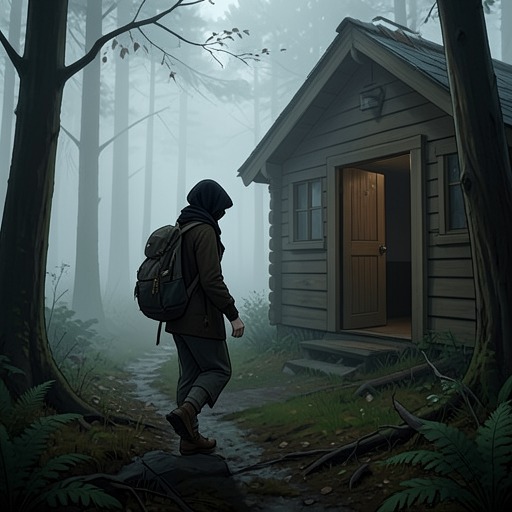
Y/N reaches Vampire Castle after being abandoned by her mother. Her mother tells her to leave the car, closes the door, and drives away quickly, leaving Y/N alone and unable to see the car anymore. Later, near midnight, Y/N sees a giant castle in the distance and decides that it may offer shelter. Heavy rain begins as she runs toward it, and the castle’s size impresses her even before she enters.
The entrance produces an immediate contrast between apparent refuge and concealed danger. The door is already open, allowing Y/N to walk inside without overcoming a physical barrier, but the interior is very dark. She proceeds through a dark corridor until she collides with someone, who tells her to watch where she is walking. The open door therefore does not signify welcome; it draws an isolated traveler into an unknown interior whose inhabitants remain initially unidentified.
Interior Spaces and Everyday Movement
The castle contains sharply contrasting zones. Its giant library is large enough to resemble a maze, with numerous books and footsteps near the door forcing Y/N to run inside. The library offers concealment, but its abundance of passages and books also makes knowledge spatially difficult to control. It is a place where Y/N can evade immediate pursuit while becoming more deeply enclosed in the castle’s structure.
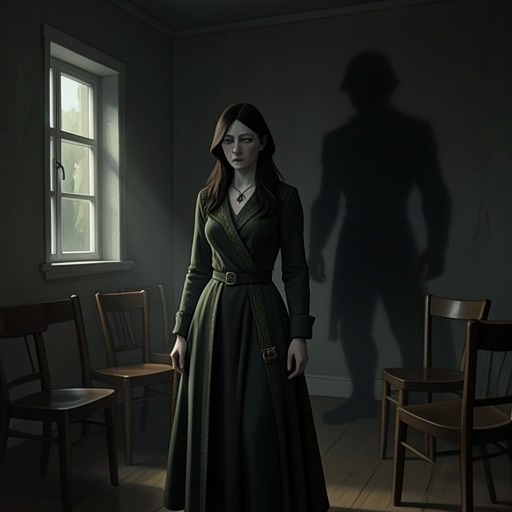
Another part of the castle is cleaner and brighter, with clean walls, clean windows, ordinary hanging lights, a swimming pool, a painting room, and other rooms filled with colorful walls. This section feels more enjoyable than the darker part of the building. The contrast shows that Vampire Castle is not uniformly oppressive: it contains spaces of recreation and apparent normality alongside corridors and rooms associated with fear. Yet the brighter rooms remain part of the same structure, so comfort never fully separates itself from the castle’s supernatural household.
Y/N gradually learns the castle through repeated movement. She goes to the gaming room because V and Jungkook often enter it, although she has never previously been inside. Later, RM stops in front of the door leading to the mirror, opens it, and enters with Y/N and Suga following. These movements establish that the castle’s rooms are organized by access and familiarity: some areas become known through the habits of its residents, while others conceal routes whose significance only emerges when characters cross them.
Castle, Vampires, and Threatened Refuge
The castle becomes associated with the seven vampires and with Y/N’s unstable relationship to them. After leaving it, Y/N eventually finds a road and a city, but the castle remains the central point from which her encounters with its inhabitants unfold. J-Hope is later found in connection with Y/N’s attempt to escape, and he asks why she ran away, making clear that departure from the castle is not a simple act of travel but a contested separation from the vampire household.
The building’s inhabitants also make its spaces unsafe in shifting ways. A person occupying Jungkook’s body forces Y/N toward the door while she struggles, turning an ordinary exit into a scene of bodily coercion. Elsewhere, a shadow pulls Y/N through a mirror after Jin’s body falls to the ground. The castle thus contains threats that do not merely attack from its corridors; they can seize control of bodies and convert architectural surfaces into entrances. The familiar house becomes a place where identity, possession, and physical boundaries are repeatedly unsettled.
The castle’s domestic dimension remains visible even during danger. From Y/N’s perspective, the others are still present in her thoughts, and a later shift to the BTS point of view shows Jimin and V arguing over a cookie. This brief glimpse of ordinary interaction complicates the castle’s horror. It is simultaneously a threatening supernatural stronghold and a lived-in household in which the vampires quarrel, play, and share routines.
Mirrors and Hidden Passageways
The mirror room gives Vampire Castle its most consequential spatial function. When the shadow pulls Y/N inside the mirror, the surface feels like water and Y/N finds herself inside it. The mirror is therefore not a passive object or decoration. It is a permeable boundary through which the castle opens onto imprisonment and other-worldly movement.
The route to the mirror is itself controlled by the castle’s interior geography. RM identifies the relevant door, and Y/N enters with Suga. This sequence presents access to the mirror as something mediated by a resident who knows the castle’s layout. Knowledge of the building grants practical power, while following another character through its rooms can expose Y/N to dangers she does not yet understand.
The castle also becomes the setting for reversals in which escape and confinement exchange places. Y/N can run through its rooms, hide in the library, or approach doors, but mirrors can interrupt ordinary movement by drawing her into another realm. Conversely, the castle’s hidden routes allow supernatural forces to reach her. Its architecture therefore operates as a system of thresholds rather than a stable container: doors, corridors, and mirrors repeatedly change the direction and meaning of travel.
Later Confrontation and Narrative Significance
The castle remains connected to the story’s largest supernatural conflicts. During the confrontation with Gehan, Y/N pushes him away and imagines the gates of hell into existence, producing rumbling as the struggle moves toward a decisive transformation of the surrounding reality. The castle’s significance lies not only in housing earlier encounters but also in serving as a stage from which the story’s spatial order can be challenged and remade.
The blood-red moon later falls as a red light onto Y/N, freeing her movement at a moment when she is stuck. Y/N’s light and dark selves then hold hands in a triangle and concentrate together. These scenes shift the castle’s role from a place of external pursuit to a site associated with the integration of divided identities and the recovery of agency.
At the end of the supernatural sequence, Assiah gathers the others into a small group and uses energy to make them slowly disappear, sending Y/N toward a new home while the remaining characters must determine what follows. The castle’s narrative function consequently culminates in separation and reorganization. It begins as a refuge discovered by an abandoned child, becomes a maze inhabited by vampires and crossed by mirrors, and ends as part of a larger process in which identities, relationships, and lives are removed from their former arrangement.
Vampire Castle is therefore a gothic architecture of transition. Its darkness externalizes uncertainty, its library embodies concealed knowledge, its recreational rooms preserve an image of domestic life, and its mirror room turns the house into a passage between worlds. Every apparent shelter carries the possibility of capture, while every forbidden route can become a means of escape or transformation. The castle’s decisive power is its ability to make place itself unstable: entering it changes Y/N’s story, and moving through it repeatedly changes what safety, home, and separation mean.